


Smart Fridge for employee catering in the company
In companies, employee catering today needs above all one thing: easy access to food & drinks – without a canteen and without staffing effort. A Smart Fridge provides snacks, lunch options and drinks 24/7: ideal for everyday office life, meetings, late shifts or flexible working hours.
Employees take products directly from the fridge and pay cashlessly (e.g. card, smartphone or employee card); optionally, meal subsidies or internal payment models can be mapped – and thanks to transparent analytics on demand and assortment, catering remains plannable for teams.
Plannable employee catering – without staffing effort
Many companies offer no reliable catering in everyday life – according to a survey, 80% of employees in Germany have no professional or regular catering option at the workplace. A Smart Fridge closes this gap as a self-service mini-canteen: fresh ready-to-eat options such as bowls, salads, wraps, sandwiches, snacks and drinks are available around the clock. The assortment can be adapted to the location and team – without the infrastructure and ongoing effort of a traditional canteen.
Employee catering 24/7 in the office
The Smart Fridge gives employees access to snacks, drinks and fresh meals at any time – right at the company, without a canteen and without additional organizational effort.
Freshness & variety in everyday work
Several times a week, the Smart Fridge is restocked (optionally by a service partner) with high-quality food and drinks – for varied office catering with ready-to-eat options.
An employer benefit that gets used
With modern company catering, you strengthen satisfaction and loyalty within the team. Optionally, an employee card, meal subsidy or internal payment models can be integrated – tailored to your HR and location goals.
Easy to use, strong in effect
Employees take products on a self-service basis and pay cashlessly (e.g. by card or smartphone). This makes employee catering in the company fast, reliable and fit for everyday use.
Supply more sustainably instead of wasting
A needs-based assortment, plannable restocking and transparent demand reduce overstocking and food waste: a practical lever for more sustainable catering in the office.
Control & analysis included
Telemetry and reports give you an overview of stock, demand and sales trends. This lets you optimize assortment and restocking based on data – for efficient operation and better profitability.
Livello's inventory management system
The IoT control and management system
The Livello Cloud monitors operations in real time and helps to manage stock, demand and restocking in a plannable way. This allows assortment and product flow to be optimized according to need – so that the right items are available at the right time in the right place. More details in our blog.
Employee catering without a canteen – orientation & options
Which solution fits your team size, location and effort? The following articles show how company catering has evolved and what alternatives there are when a traditional canteen is dropped or supplemented.
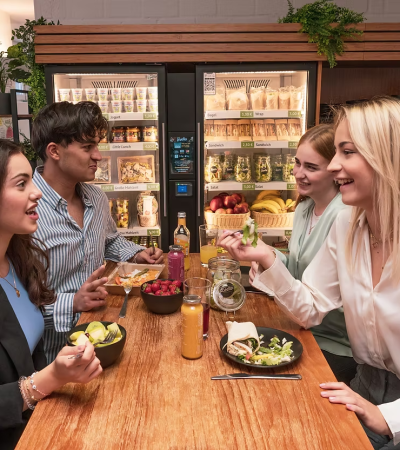
From the canteen to modern employee catering: the evolution of company catering
The article shows how company catering has evolved from the canteen to flexible, location-appropriate concepts – and which criteria matter today when making a choice.
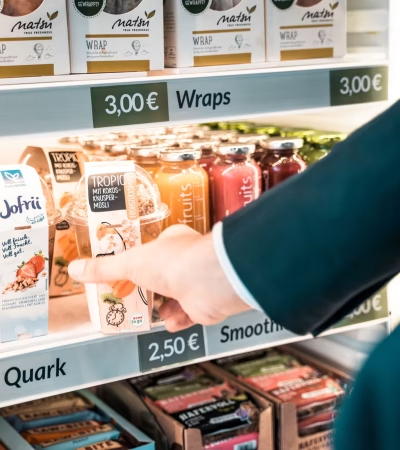
No canteen? No problem: alternatives to traditional employee catering
A clear overview of alternatives to the canteen shows which option fits best depending on effort, budget and team structure.
This is a perfect fit for your company:
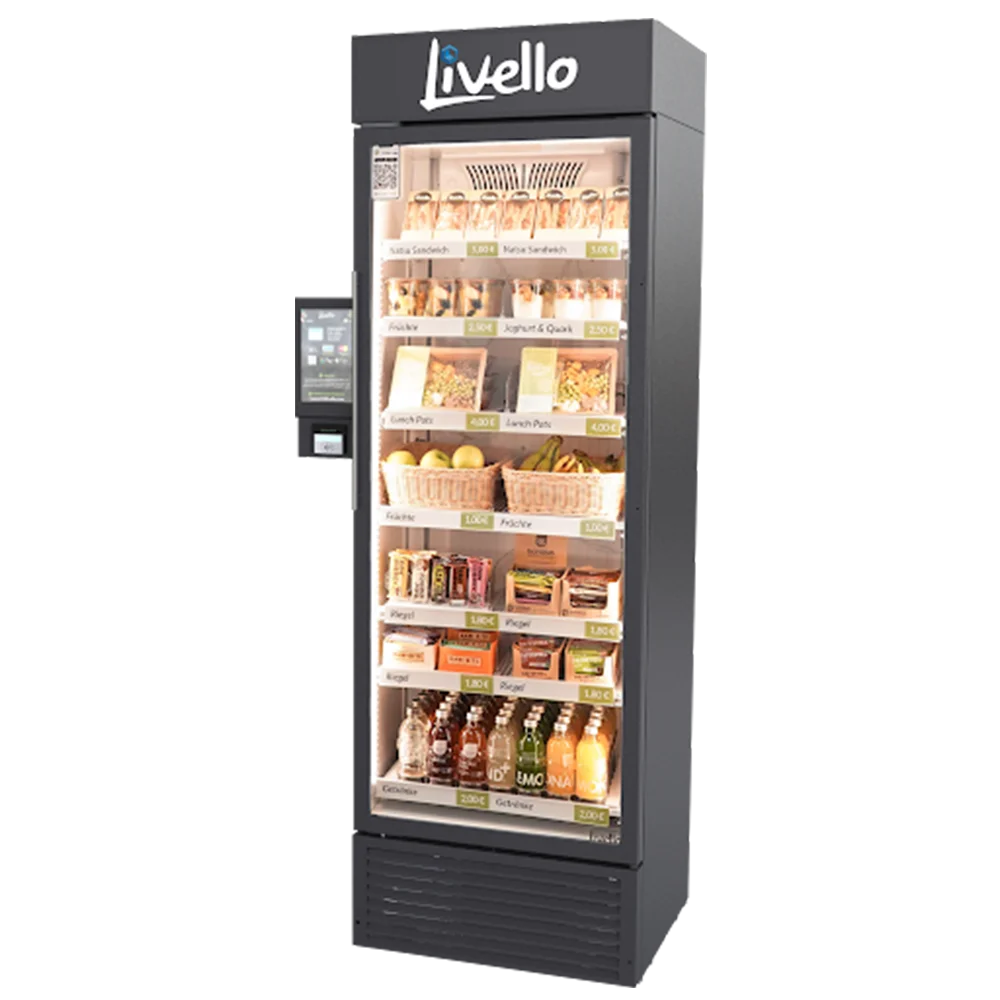
Livello single fridge
Our smart innovation
Livello single fridge
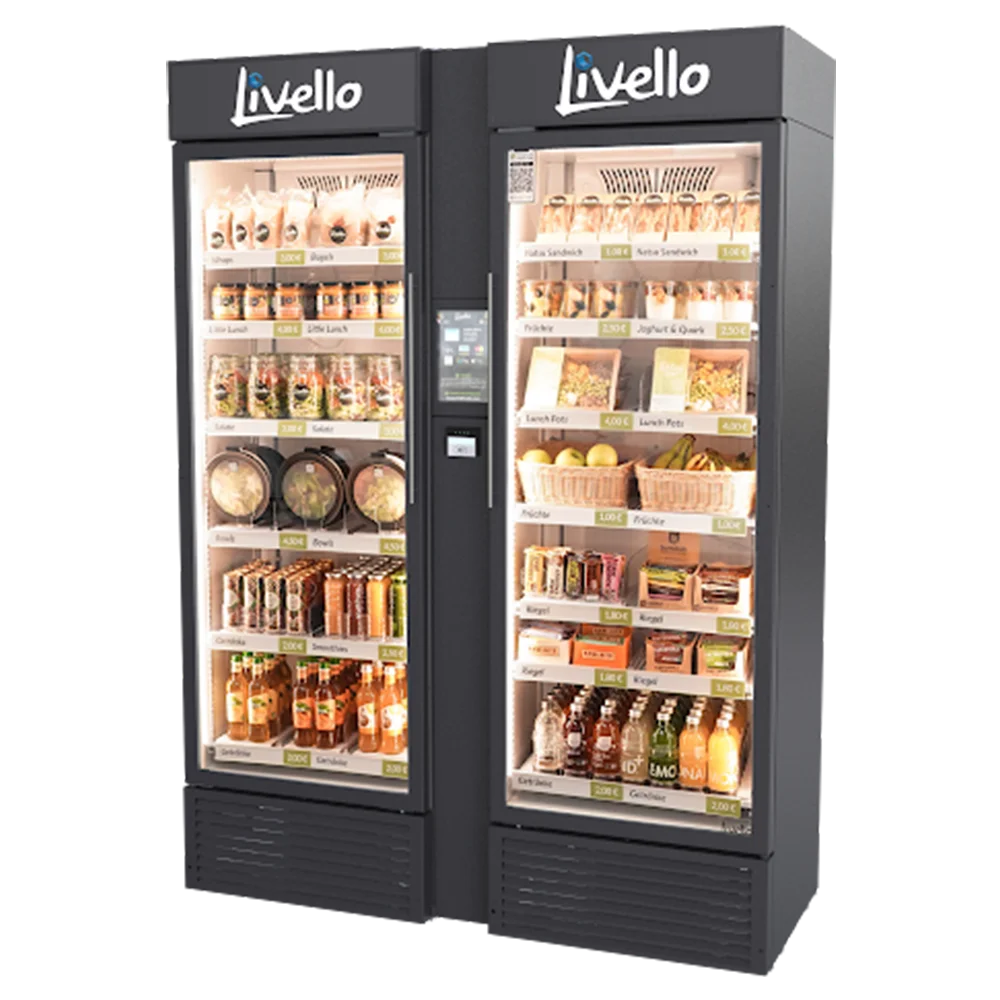
Livello double fridge
More capacity
Livello double fridge
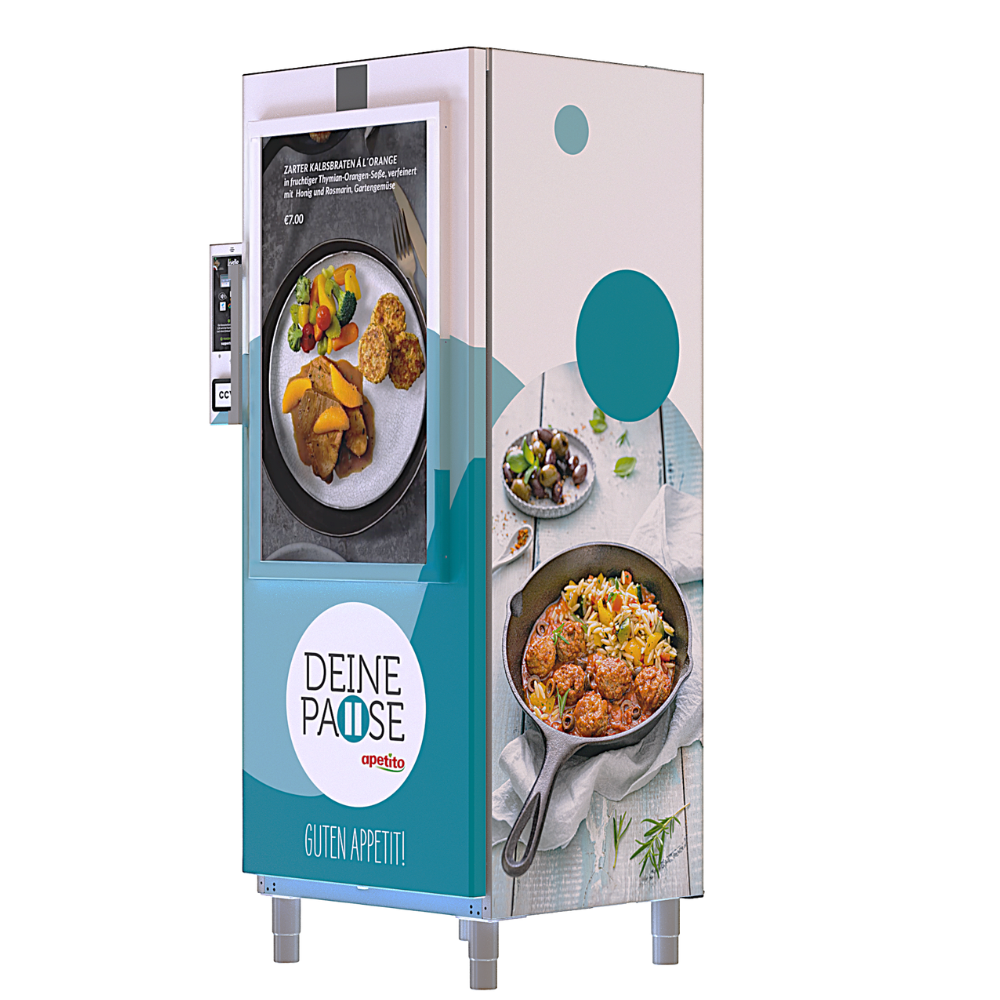
Custom builds
Individual product solutions
Custom builds
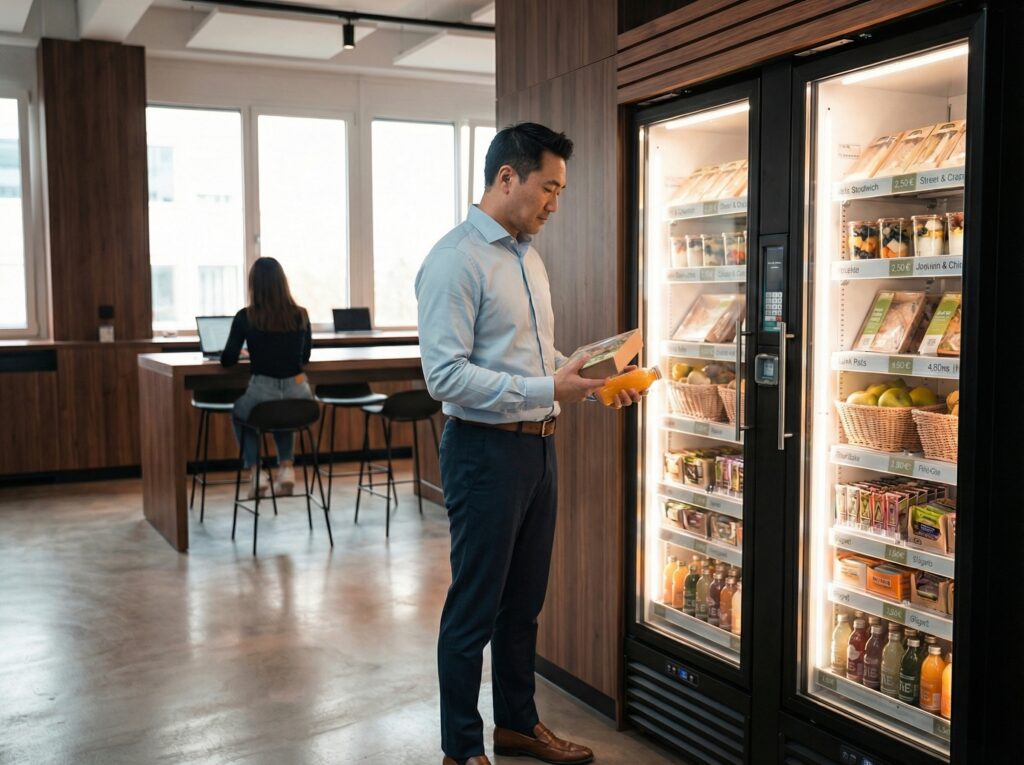
Implementation in the company: how employee catering becomes reliable in everyday life
Live in 4 steps: from the site check to operation
Check the location: floor space, power, internet – plus a spot that is visible and easily accessible in everyday life (e.g. kitchen/lounge).
Define the operating model: stock in-house or use a service partner – depending on how much internal effort is desired.
Start the assortment (don’t „plan it perfectly“): begin with a clear core assortment for lunch, snacks and drinks – and refine it based on data after the first few weeks.
Define payment & rules: cashless (card/smartphone) as standard; optionally an employee card, subsidy or internal payment models – including clear communication to the team.
Operating concept: two models, one goal
For employee catering with a Smart Fridge, there are two common operating models. Both pursue the same goal: high availability and a reliable offering in everyday life.
In-house
Take full control of your employee catering while protecting your budget at the same time: stocking it in-house is the smart choice for everyone whose internal logistics already run smoothly. With just 10 minutes of effort a day, you put together an individual assortment by budget or nutritional profile, while we professionally support you with the right partner network, smart payment systems and tips on subsidization. Whether sustainable, cost-efficient or precisely managed – this model turns your break-time catering into a flexible, self-running solution that creates real value especially for smaller locations.
Stocking by a service partner
Opt for the all-round, worry-free package: stocking by a service partner is the ideal choice for companies that want first-class employee catering without lifting a finger. Especially for larger organizations or teams across multiple locations, this model offers maximum relief, since no internal processes for purchasing or logistics need to be set up. If the budget is available and you want to focus fully on your core business, our experienced partners handle the entire stocking – reliably, professionally and completely effort-free for your team.
Regardless of the model, one thing above all determines acceptance in everyday life: the desired products must be available, and the purchasing process must work quickly and smoothly.
Do you have questions?
We already have a few answers ready for you here.
A recent YouGov study commissioned by Sodexo (survey: 1,000 employees working in buildings) shows: 24% are dissatisfied with the catering offering at their workplace, and only 33% have access to a staff restaurant; 14% have a kiosk or cafeteria in the building.⁽¹⁾ These figures suggest that many sites cover catering only partially – especially outside traditional lunch times. This explains why 24/7 solutions (e.g. Smart Fridges/micro-markets) are in practice often used as a supplement or alternative to the canteen. The recommendation is to first measure the offering and its usage (site analysis), then choose the concept so that off-peak times and varying attendance are reliably covered.
[1] https://www.sodexo.de/presse/2025/studie-verpflegung-hygiene-jobzufriedenheit
Hybrid work remains stable in Germany: in February 2025, 24.5% of employees worked at least partly from home.⁽¹⁾ This tends to make rigid canteen models less plannable, while flexible, modular solutions are gaining importance (assessment). At the same time, cashless is growing in the self-serve market: in Europe, cashless systems are installed on 85% of the „pay vend“ base according to EVA.⁽²⁾ Insights-to-action: rely on flexible supply (24/7 + modular assortments) and plan cashless/identity (e.g. an employee card) as a standard, not as a „nice to have“.
[1] https://www.ifo.de/en/facts/2025-03-24/working-home-rate-germany-stabilizes-just-under-25-percent?utm_source=chatgpt.com
[2] https://www.vending-europe.eu/new-eva-market-report-reveals-that-growth-is-slowing/
With Livello, companies can either stock the fridge themselves (in-house) or work with a service partner – both are common, and the right approach depends primarily on internal resources and the number of locations. In-house often makes sense if logistics/purchasing already exist or if certain product standards are to be managed internally. Service partners make sense if the organizational effort should remain minimal or if several locations need to be supplied reliably. We usually recommend choosing the model with the lowest start-up effort for the pilot, and then optimizing for efficiency based on real usage data. What matters is not „who stocks it“, but whether availability and assortment are consistently right – which can be ensured through clear restocking routines and data from operations.
Via the Livello Cloud, you can see stock levels, sales, peak times and legally compliant temperature logs. Exports for accounting/controlling are possible at any time – for full transparency and efficient planning.
You create items centrally and adjust prices, names, SKUs, tax rates or planograms. Changes are applied promptly at the kiosk.
In practice, three points are decisive: power, a stable internet connection and a location that is easily accessible in everyday life (e.g. kitchen, lounge, near meeting rooms). In addition, it should be clear how restocking, cleaning and internal responsibilities are organized – this is often more important than the technology. If the fridge is too hidden or no one takes ownership, usage and availability drop noticeably. We therefore recommend a brief site check before go-live, including walking routes and typical usage times. Better a location with high visibility and clear responsibility than „perfect“ square meters somewhere off to the side.
Yes. Any tax rate can be configured per item (including 7% and 19%). The kiosk reflects these correctly and applies them automatically.
Employees open the Smart Fridge, select products and close the door again – the purchase is thereby completed. Depending on the setup, a brief cashless pre-authorization takes place beforehand (e.g. by card or smartphone), so that the purchase can then be settled automatically. After the door is closed, the amount is charged and, if desired, a digital receipt is available. A clear signage right at the device is important („How it works in 3 steps“) so that first-time users can get through without help. For a smooth start, we recommend a brief onboarding at the location (poster + internal email) and, in the first two weeks, a look at typical drop-off points (e.g. failed pre-authorization, unclear payment rules).
Get in touch with us
We are happy to advise you
Opening hours
Mon. - Fri. : 09:00 - 17:00



Our team is happy to advise you for your company.